QX-10 1MB Memory Expansion Board
Introduction⌗
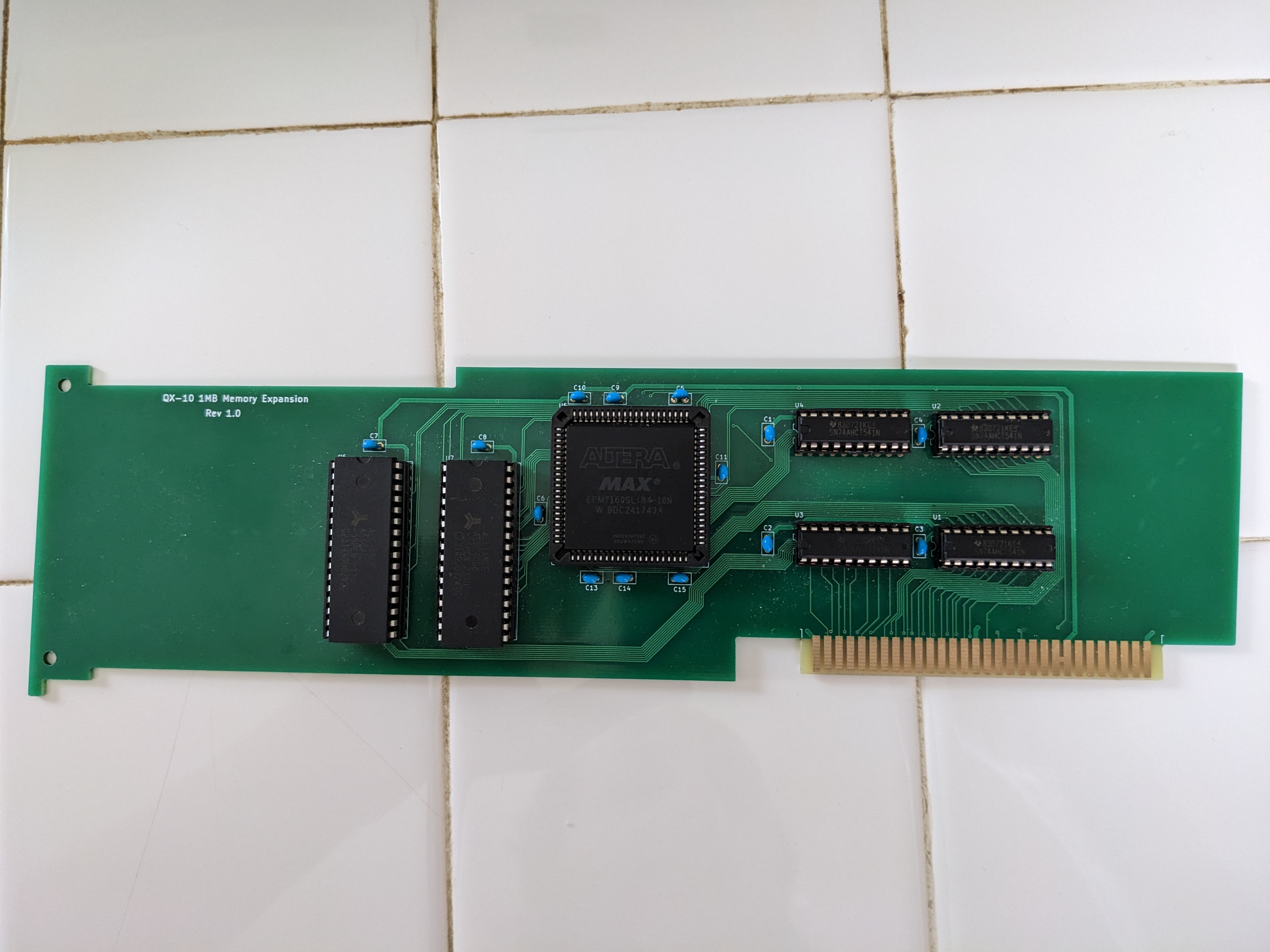
This card can provide 1 Megabyte of external memory that can be banked into the lower 56K of the QX-10’s address space. This is done by splitting the 56k of bankable memory into 7 banks, each of which can be either enabled or disabled and configured to point to 1 of 128 8k pages within the 1 Megabyte of external memory.
This design is based on the original Commodity Quote Graphics memory expansion board and should be software compatible with it.
Schematic⌗
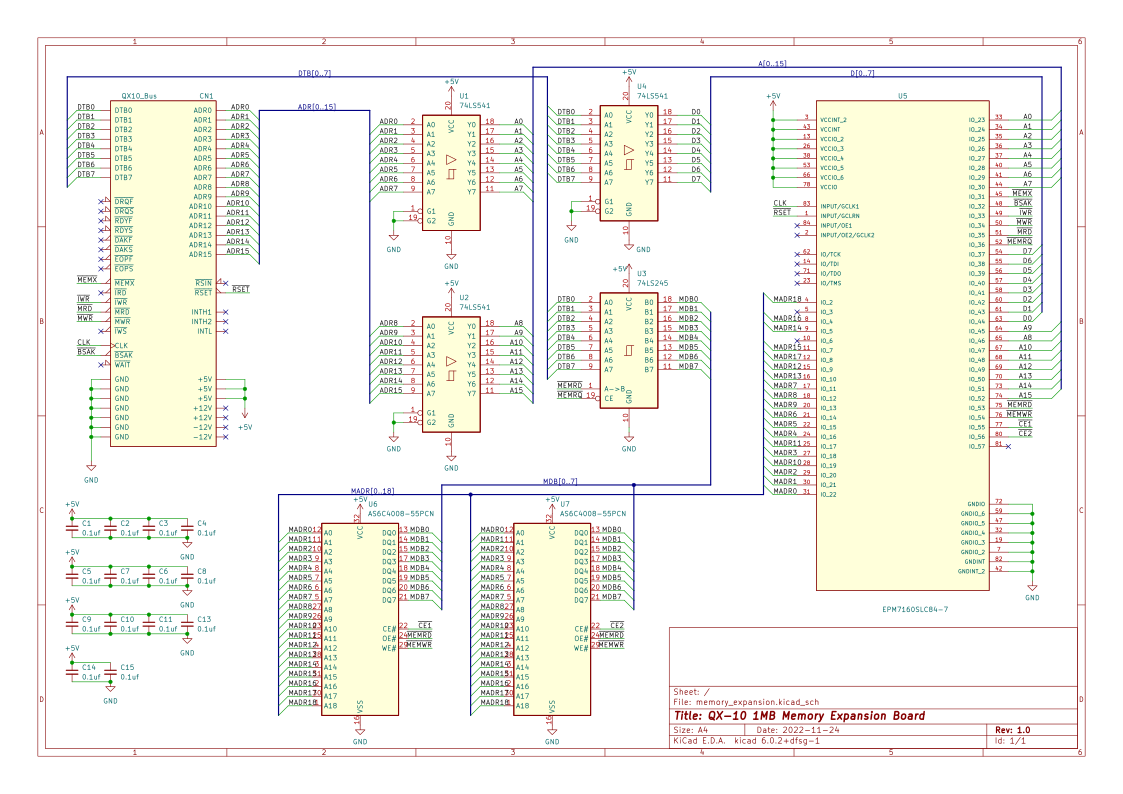
The heart of this expansion board is the MAX7160S CPLD. Besides the CPLD there are a few buffers on the address and data buses, and two 512k SRAM chips.
This CPLD was chosen due to the fact that it runs on 5 volts and was available in a PLCC package. These features allow me to avoid the need for additional circuitry for handling voltage level shifting, as well as only requiring through hole soldering by using a PLCC socket. The disadvantage is that the chip is considered obsolete and so you will need to buy one from eBay.
Bill of Materials
| Ref | Description | Part |
|---|---|---|
| C1-C11,C13-C15 | 0.1uf Capacitor | RDER72A104K1S1H03A |
| U1,U2,U4 | 74LS541 | SN74LS541N |
| U3 | 74LS245 | SN74LS245N |
| U5 (Socket) | PLCC-84 Socket | 8484-11B1-RK-TP |
| U5 | MAX 7160S | EPM7160SLC84-7 |
| U6,U7 | 512K SRAM | AS6C4008-55PCN |
CPLD Design⌗
The CPLD defines 7 bank registers at IO addresses 0xF0-0xF6 that control which 8k page of external memory is mapped into that bank. The MSB controls whether or not to enable that bank, and the 7 remaining bits set the page of external memory (0-127) to map in.
CP/M Support⌗
Other than the original Commodity Quote Graphics software, of which I could find no existing copies, the only piece of software that exists for these boards is a program used to test their functionality that was written by Scott Baker. I have updated the software slightly to test all 7 banks and work on a wider set of CP/M versions for this system.